I was reading earlier on a fuel guage post by someone that you can adjust the voltage on the cluster voltage regulator. My question is has anyone done this before ?
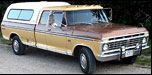
I have a 72 F-250 that will only read 3/4th's a tank of fuel when full and the post I read said that if the in cab tank is full, adjustment can be made by adjusting a screw on the regulator and that the fuel gauge is the voltage adjustment reading.
IE.... adjust the regulator screw untill the reading is full on the tank gauge and then you will actually have the 5 volts you should have.
How easy is it to get at with a screw driver while installed ?
As far as I know the cluster voltage regulator is not adjustable, but the way the regulator is built they could have made it adjustable. More than likely you have a problem with sending unit, although any high resistance in the circuit will cause erroneous readings - e.g., the switch for the twin fuel tanks. Good article on instruments.
Thanks. Out of all the reading I did on this site about fuel gages and accuracy, I only read one that mentioned that I could adjust the voltage regulator.
I am away from home, but when I get back I will look for any adjustment, if not then I will follow all the other good advise I have seen here on checking the gauge and sending unit.
Just reread the link in my last message. Each gauge may be adjustable (see the sidebar on the link.) THEY SUGGEST CAUTIOUS ADJUSTMENT IN FINITE AMOUNTS, THEN CHECK THE GAUGE FOR PROPER OPERATION. Otherwise, don't overdo it or you will buy new gauges.
From another site: This regulator reduces the incoming 12 volts on the I terminal to near 5 volts for both Fuel and Temp meters.
When voltage is applied, the current flowing though the coil generates the heat necessary for the bi-metallic arm to react and open the contact which stops the current. The coil then cools down and the contact closes again. This process repeats itself over and over again.
This (regulation) process reduces the voltage directly to the Fuel gauge meter and to the Temp gauge via the jumper strap.
A volt meter applied to the A terminal of the Fuel or Temp gauge should fluctuate (due to the breaking contact) near 5 volts.
Note: there have been reports of this regulated voltage being as high as 7-9 volts with no loss of gauge function.
Warning: 12 Volts applied to the Temp gauge's A terminal will cook the Temp gauge! (That notorious "puff of smoke")
Those regulators are adjustable, but its kind of a pain to do it. There is a small adjuster between the two terminals. You can turn it with a small needle nose, but its almost impossible to do while its in the dash. The regulators ground through the base, so when you take it out to adjust it the guages won't read. You need to fill the tank with gas and just turn the screw a little at a time until the guage reads full. Your other guages will also come up. A Ford mechanic told me how to do this years ago. He said that a lot of these trucks were traded in because people thought the oil pressure was bad, but the guage was just reading low, so they adjusted the guages before they put the trucks on the lot.
Turn the adjuster clockwise to increase the voltage. Here's a outside and inside pic of the IVR. By turning the adjuster clockwise, it puts more preload on the contacts which causes the arm to heat up more (more 'on' time) before the contacts break.
Barry
"Are you gonna make it all 220?"
"Yeah 220, 221, whatever it takes."
Neither did I! Thanks for that info and the great pics, Barry!
____| \__
-O-----O- Keith
'67 F-100 2WD SWB ~ '69 F-100 4WD SWB w/7" chop ~ 1975 F-250 Ranger XLT Supercab Camper Special My '67 restoration video -> Posting and you!<-a MUST watch for all!!
Learned something too. All the IPVRs I have looked at have an adjustment screw. Interesting what QC said about mechanics adjusting IPVR to show additional oil pressure. When I researched the IPVR before, one of neat things about the mechanical IPVR is that it compensates for temperature because it is mechanical. The solid state IPVRs don't. Some have built solid state IPVRs to really get a steady voltage. The mechanical IPVR gives a spikey voltage, i.e., read additional static for the radio. I looked for over an hour and could not find the diagram/drawing of the mechanical IPVR that I had found before. This is a photo of an early model that is on eBay - looks like the little knob is the adjustment.
bluef250, you make an excellent point about the mechanical regulator being able to compensate for temperature. That's the main reason I don't like any of the solid-state replacements. Plus the SS ones are big and pump out a lot of heat!
The gauges used in our vehicles are thermoelectric, they use pulsating current to heat a wire that is closely bound to a bimetallic spring that the gauge pointer is attached to. The bimetallic spring has different metal types on each side, as it heats up from the hot wire around it, the spring deflects due to the different coefficients of expansion of the different metals. As with all thermoelectric devices, they can be affected by changes in ambient temperature. When the ambient gets colder, for the same current duration that the IVR applies the gauge needle would deflect less and vice versa it would deflect more when it gets hotter. You don’t see these differences because the stock IVR is temperature compensated. The IVR works very similar, it uses a hot wire in series with a bimetallic spring that makes and breaks the current thru a set of points. Normally the spring is closed completing the circuit until the hot wire eventually causes the spring to deflect enough and open the points. Once open it cools and eventually closes, repeating the cycle over and over. Now when the ambient temperature gets colder it takes the IVR longer to heat up to the same temperature to break the connection. This is good because the gauge is colder and needs a longer current duration to deflect to the same reading. When the ambient is hot, the IVR takes shorter to heat up. Again, this is good because the gauge doesn’t need as much current duration to reach the same deflection.
Sorry this got kind of wordy. Another way of saying it is when it’s cold the IVR works harder to heat up which compensates for the gauges needing more current duration. When it’s hot the IVR has an easier time heating up which also compensates for the gauges not needing as much current. The point of all this is the SS 5 volt regulator always pumps out 5 volts no matter what the ambient or load conditions are, that’s what they’re designed to do. Admittedly, I don’t know how much off the gauges would be with a constant source and wide ambient temperature swings but Ford and other tech manuals all make a point and mention this temperature compensation.
Oh, all vehicles with a radio have a noise-suppression choke installed on the IVR, it's just some solid enameled wire wound around a form.
Barry
"Are you gonna make it all 220?"
"Yeah 220, 221, whatever it takes."
sandman, sorry for getting a little off-track. I wanted to tell you that I've heard a LOT of '71 and '72 trucks with the same symptoms as yours, there's something chronic. Maybe do a quick check of the fuel gauge first before you start adjusting? If you do adjust up, all your other gauges will adjust up.
Barry
"Are you gonna make it all 220?"
"Yeah 220, 221, whatever it takes."
Over time my 72 only showed 3/4 of a tank. I thought it was the sending unit and changed it out with a brand new one. Much to my disappointment it still shows 3/4 full when full. I can't wait to try the adjustment out. I guess I'll have a spare sending unit now.
My '71 is the same way. Reads 3/4 when full, and the oil and temp gauges read low too. I'm going outside right now to find my spare gauge cluster and take a close look at the regulator.
One thing though, when my tank is empty, the gauge still reads 1/4. Anyone had that happen?


 I haven't done it yet but I am interested because my gas gauge also reads 3/4 when full.